
Daily basketball trivia is having a moment, and the reason is simple: a fresh puzzle every day is the most painless way ever invented to actually get better at something. You don't sit down to study NBA history — you just answer a few questions over your morning coffee, the same way millions of people now do a daily word puzzle. Do that for a month and you'll know more about the league than you ever did from years of passive watching. The trick is the format. A daily basketball trivia game is small enough to finish in two minutes, hard enough to teach you something, and resets every 24 hours so there's always a reason to come back. This guide explains exactly how the daily format works, why a little bit every day beats a once-a-month cram session, the six question formats you'll run into, and how to turn it into a habit that actually sticks.
What "Daily" Basketball Trivia Actually Means
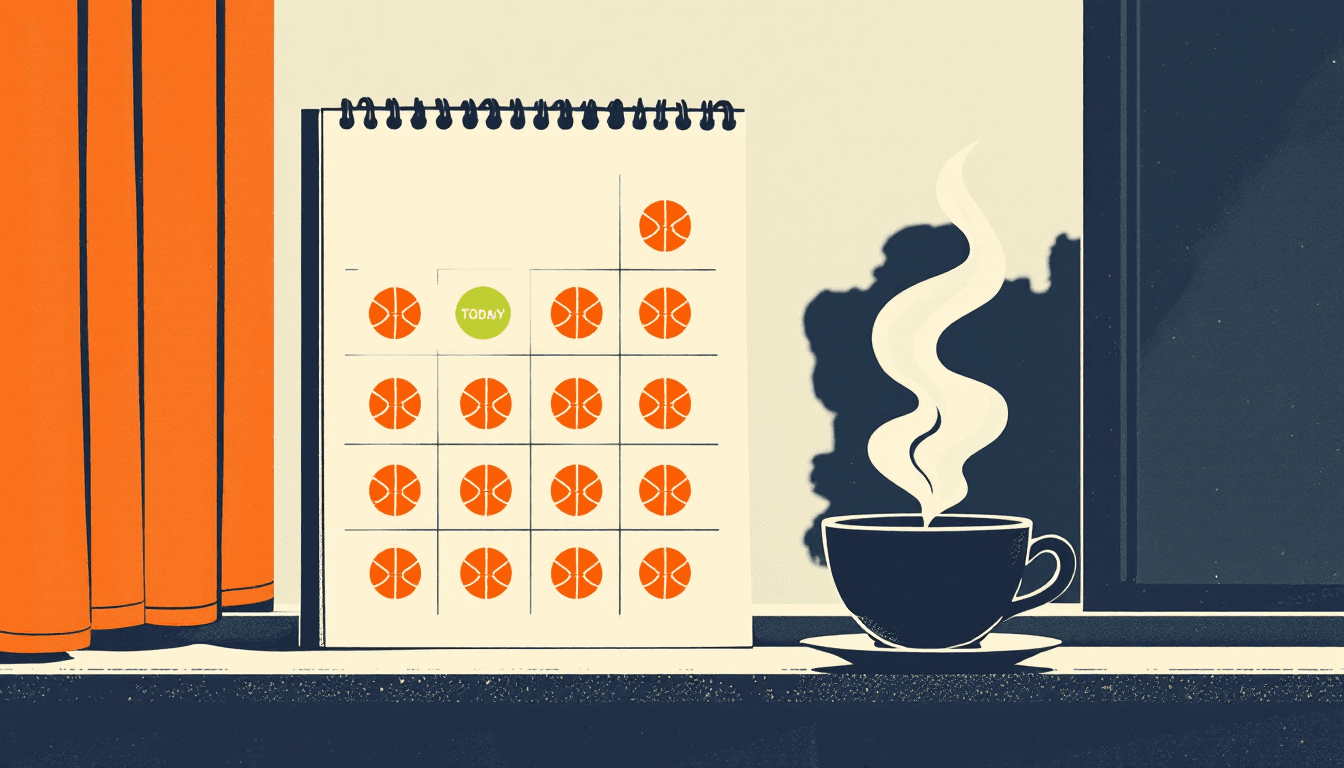
The "daily" in daily basketball trivia isn't just marketing — it's the entire design. A daily trivia game gives everyone in the world the same set of questions, all at once, and replaces them at a fixed time each day. That single constraint changes everything about how the game feels.
Because the puzzle is the same for everyone, it becomes a shared event. You and a friend on the other side of the country are solving the identical board, so you can compare results, argue over the tricky clue, and trash-talk about who got the higher score — all without coordinating a thing. Because it resets daily, there's a built-in rhythm: miss today's and it's gone, but tomorrow's is always coming. And because it's bounded — a fixed number of questions, no infinite scroll — it never overstays its welcome. You finish, you get your score, you're done until tomorrow.
That's the same loop that made daily word games a global phenomenon, and it works just as well for hoops. The scarcity is the point. One puzzle a day keeps it special.
Why a Daily Habit Beats Cramming
Here's the part most people get backwards. If you wanted to learn NBA history, your instinct might be to read a long list of facts and try to memorize them. That's the least effective thing you can do. The science of learning is clear on two points, and daily trivia is built around both.
The first is retrieval practice. You remember information far better when you're forced to pull it out of your memory than when you simply re-read it. Every trivia question is an act of retrieval — and crucially, the questions you get wrong create the strongest memory hooks of all. Blanking on a question and then seeing the answer burns it in deeper than reading that same fact ten times in a textbook. A daily game is a retrieval machine: it makes you guess before it tells you.
The second is spacing. Cramming twenty facts into one session and never revisiting them means you'll forget most of them within a week. Encountering a few facts a day, every day, spaces your exposure out over time — and spaced repetition is how memories move from short-term to permanent. A daily basketball trivia habit spaces your learning automatically, just by virtue of being daily. You're not studying harder than the person who crams. You're studying smarter, in smaller doses, on a schedule that happens to match how memory actually works.
The Six Daily Basketball Trivia Formats
Not all trivia questions are built the same. A good daily basketball trivia rotation mixes formats, because each one trains a different kind of recall. Here are the six you'll see most often — and the specific skill each one builds.
- Top 10 / leaderboard recall. You're given a category — say, all-time scoring leaders — and have to name the players on it from memory before your guesses run out. This trains active recall of the deepest kind: there are no options to recognize, just a blank you have to fill.
- Bingo / grid matching. A 4×4 board of category tiles (an award, a team, a stat milestone) that you fill by naming players who qualify. This builds associative knowledge — connecting players to the many buckets they belong in.
- Higher or Lower. Two players, one stat; you guess whose number is bigger. It's binary, so even a guess teaches you the comparison. This is the gentlest on-ramp and the best for learning relative stats.
- Who Am I? / mystery player. A hidden player revealed through progressive clues — draft position, teams, awards — where guessing earlier scores higher. This trains deductive reasoning across a player's whole career.
- Connections / grouping. Sixteen players sorted into four hidden categories of four, with deliberate decoys. This is the hardest pure-knowledge test, demanding you see the category a player fits, not just recognize the name.
- Two Truths and a Lie. Three statements about a player; two true, one false. This sharpens your eye for the exact detail — the wrong award, the wrong team, the year that's slightly off.
A daily set that rotates through all six hits every angle of NBA knowledge in about ten minutes total.
How to Build a Daily NBA Trivia Routine
Knowing daily trivia works is easy. Actually doing it every day is the part that requires a little design. A few principles make the habit stick.
Anchor it to something you already do. The most reliable way to build a new habit is to attach it to an existing one. Play your daily trivia right after you pour your coffee, or on the train, or during the first ad break of the game you're watching. The existing routine becomes the trigger.
Keep the streak visible. Streaks are the single most powerful motivator in daily games — once you've played 12 days in a row, you really don't want to be the reason it resets to zero. Track it, and let that small daily stake pull you back.
Start with the easy formats. If you're newer to NBA history, lead with Higher or Lower and Who Am I? before tackling Connections. Early wins build momentum; early frustration kills habits.
Play with people. Comparing scores with friends turns a solo task into a social one, and social accountability is far stickier than willpower. A group chat where everyone drops their daily score is the cheapest habit-enforcement tool there is.
Don't chase a perfect score. The goal isn't to be right — it's to be exposed. A day where you miss four questions teaches you more than a day where you sweep. Let yourself be wrong, then read the answer.
A Sample Daily Basketball Trivia Round
Here's what a mixed daily round might look like — five questions across formats and difficulties. Cover the answers and play it like the real thing.
- (Easy) Which franchise has won the most NBA championships? (The Boston Celtics, with 18.)
- (Higher or Lower) Who has the higher career scoring average — Michael Jordan or anyone else in history? (Jordan, at 30.1 points per game — the highest of all time.)
- (Medium) Who is the NBA's all-time career assists leader? (John Stockton, with 15,806.)
- (Who Am I?) Drafted 41st overall in 2014, this center has since won three MVP awards. (Nikola Jokić.)
- (Hard) Who holds the record for most points in a single game? (Wilt Chamberlain, with 100, on March 2, 1962.)
How'd you do? If you got all five, you're past the casual stage. If you missed one or two, you just found exactly what to study — and that's the whole point of playing daily. The questions you miss today are the facts you'll own by next week.
What a Month of Daily Trivia Actually Does
People underestimate daily habits because the daily payoff is invisibly small. Three or four facts a day doesn't feel like progress. But the math is the same compounding that makes daily habits powerful everywhere else, and it follows a predictable arc.
Week one is the awkward stretch. You'll miss a lot, especially outside the era you grew up watching, and the formats themselves take a few days to click. Don't judge the habit here — you're still learning how to play, not yet learning the league.
Weeks two and three are where it turns. The facts you missed in week one start reappearing, and because you got them wrong the first time, they stick the second. You'll notice yourself recognizing a mystery player from fewer clues, or instantly knowing which of two players scored more. This is retrieval practice and spacing doing their quiet work.
By the end of the month, the shift is unmistakable. You're no longer guessing on the easy and medium questions — you know them — and your misses have migrated up into genuinely hard territory: single-game records, obscure award years, deep-cut draft trivia. That's the signal you've graduated from casual to committed. The fan who watched basketball for ten years without ever testing themselves often plateaus; the one who plays a daily quiz for thirty days blows past them, because thirty days of active recall beats ten years of passive watching.
None of this requires talent or a good memory. It requires showing up for two minutes, being willing to be wrong, and coming back tomorrow.
Sticking With It
The honest truth about daily basketball trivia is that it doesn't feel like learning, which is exactly why it works. Real studying requires willpower, and willpower runs out. A two-minute puzzle attached to your morning coffee requires almost none — and yet the compounding is real. A single day teaches you three or four facts. A year of single days teaches you more NBA history than most fans pick up in a decade of watching, because watching is passive and answering is active. The fan who plays every day isn't smarter than the one who crams before a bar trivia night. They've just found a schedule that matches how memory actually works, and made it small enough to never skip. Pick your format, anchor it to a daily habit, keep the streak alive, and let the slow accumulation do its thing. In three months you won't recognize how much you know.
And the beauty of daily basketball trivia is that there's no finish line to dread. You're never "behind," because each day is a clean slate with a brand-new puzzle. Miss a few days and you haven't failed a course — tomorrow's questions are waiting exactly where they always are. That low-stakes, always-fresh quality is what separates a daily habit from a study plan, and it's why so many people who could never stick with flashcards happily play a daily quiz for years. The goal was never to memorize the NBA record book in a weekend. It was to enjoy learning it, one small day at a time.

Related Reading
- NBA Trivia Questions and Answers (Easy to Hard)
- Basketball Trivia for Beginners: Start Here
- 10 NBA Trivia Tips Every Basketball Fan Should Know
- Best NBA Trivia Games to Play Online in 2026
The best way to start a daily basketball trivia habit is to play one today. airball.gg drops six brand-new NBA trivia games every morning — one in each of the formats above — all free, all the same for everyone. Begin with the daily Higher or Lower quiz to warm up, then test your deeper recall with Who Am I?. Come back tomorrow and your streak starts climbing.