
The lowest scoring game in NBA history happened on November 22, 1950, when the Fort Wayne Pistons defeated the Minneapolis Lakers 19-18 — a combined 37 points across an entire NBA game. It was a deliberate stall, not a defensive struggle. Fort Wayne head coach Murray Mendenhall decided his only chance against the most dominant team in basketball was to stop playing basketball, and the rules at the time gave him every legal right to do exactly that. Players stood at center court with the ball tucked under their arms. Possessions stretched to three minutes without a shot. The crowd — there to watch the great George Mikan — booed through every quiet minute. Fort Wayne won, but the victory felt less like basketball and more like a warning: something had to change. The game has stood untouched as the league's scoring nadir for over seventy years, and the rule it forced into existence is still ticking on the wall of every NBA arena today.
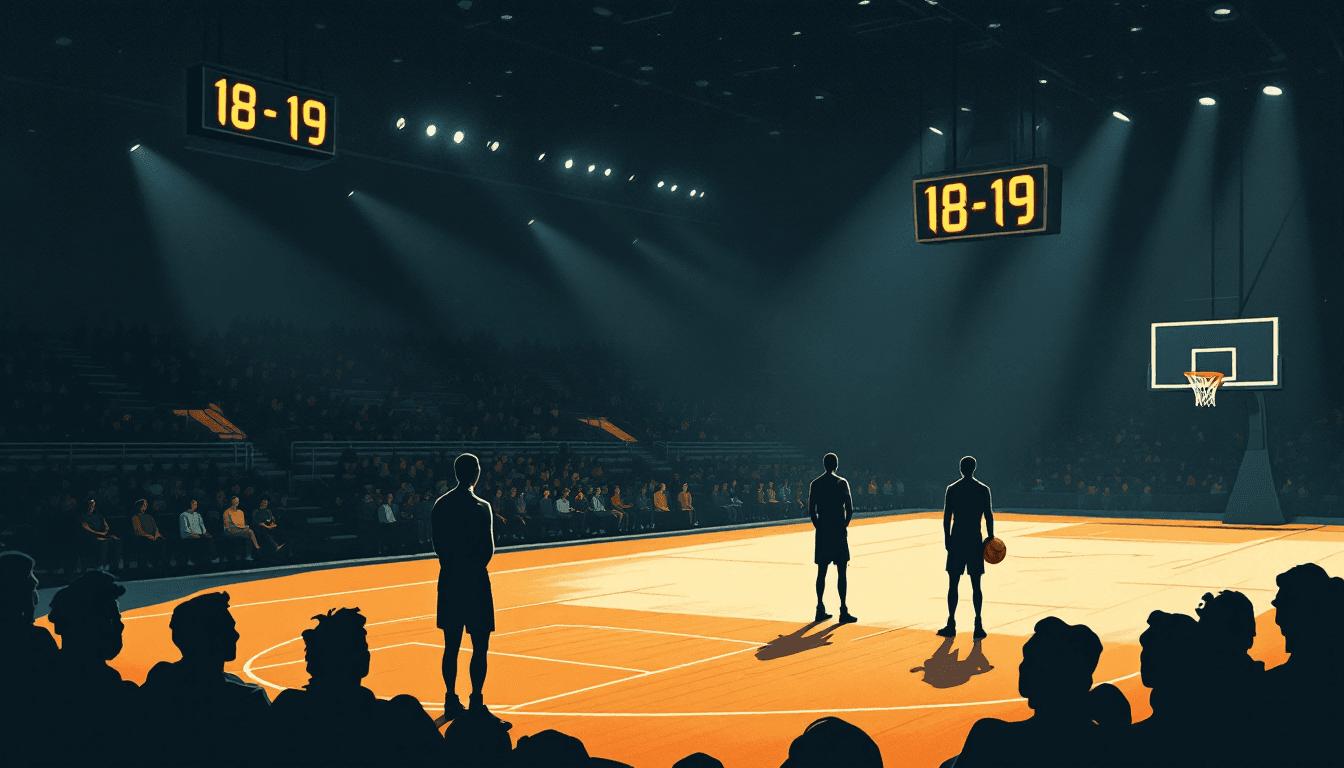
The Game: Fort Wayne 19, Minneapolis 18
The setting was the Minneapolis Auditorium, a Tuesday night in late November, and the Fort Wayne Pistons had no intention of playing a normal game of basketball. From the opening tip, Mendenhall's plan was in effect: when Fort Wayne had possession, they held it. Full stop. Players stood at center court and waited for a Laker to come out and challenge them. When one player tired of holding the ball, he'd pass it to a teammate, who would tuck it away and wait again.
The Minneapolis Lakers were the league's juggernaut — they had won three of the last four BAA/NBA titles and were anchored by George Mikan, the 6-foot-10 center who led the league in scoring at 28.4 points per game that season. Mendenhall had done the math. Letting Mikan and the Lakers run their normal offense was a losing proposition. Eliminating the offense entirely was the only strategic alternative the rulebook allowed.
George Mikan scored 15 of Minneapolis's 18 points and was responsible for four of the team's five field goals on the night. The rest of his team went scoreless from the field — 0-for-6. Larry Foust, Fort Wayne's rookie center averaging 13.5 points per game that year, cut to the basket with six seconds left and scored the game-winning layup over Mikan to seal it at 19-18. The combined 37-point total was, and remains, the lowest in NBA history. Fort Wayne's stall also ended the Lakers' 29-game home winning streak — the longest the franchise had built up to that point.
What the Rules Allowed
To understand why 19-18 was even possible, you have to understand what the NBA rulebook looked like in 1950. There was no shot clock. None. A team with possession of the basketball could hold it for as long as they chose — for the entirety of a quarter, for an entire half, theoretically for an entire game. The only obligation was not to commit a violation or foul.
Without a shot clock, the tactical math was brutal. A team with a lead could simply stop trying to score. A team facing a superior opponent — particularly a superior interior scorer they couldn't match physically — could decide that zero points allowed was worth more than the possessions they'd give up trying to score. Mendenhall made that calculation in November 1950, and it worked. Fort Wayne shot 13 total field goal attempts in the game. Minneapolis took even fewer.
The strategy wasn't entirely new to the season — teams had been learning that the stall was legal, effective, and deeply unpopular with fans — but the Pistons-Lakers game was by far the most extreme execution of it in league history. It was the reductio ad absurdum of an exploitable loophole taken to its logical end.
George Mikan and the Dynamic Fort Wayne Was Built to Stop
The backstory matters because of who George Mikan was. He was the NBA's first dominant big man — 6-foot-10, 245 pounds, fundamentally sound and physically overwhelming in an era when the average center was 6-foot-6. He'd won scoring titles in consecutive seasons, averaged 23.1 points and 13.4 rebounds per game over his career, and led the Lakers to five championships in six seasons from 1948 through 1954. He was so dominant that the NBA had already widened the lane from six to twelve feet in 1951 — a rule change colloquially known as "the Mikan Rule" — specifically to reduce his advantages in the paint.
Fort Wayne was a capable team but not a championship contender. The Pistons finished the 1950-51 season at 32-36. Matching Minneapolis basket for basket was not a realistic option. Mendenhall's solution was logical in context and catastrophic in optics. Mikan's 15 points came almost exclusively from the rare possessions he actually saw the ball — mostly early in the game before Fort Wayne fully committed to the stall. After the first quarter, the Minneapolis Auditorium settled into a kind of hostile silence punctuated by boos. Lakers coach John Kundla was furious postgame: "Play like this," he told reporters, "will kill professional basketball."
The Rest of the Pre-Shot-Clock Era
The 19-18 game was the extreme end of a continuum, but it wasn't an isolated incident. Six weeks later, on January 6, 1951, the Indianapolis Olympians and Rochester Royals played a six-overtime game in which neither team scored in the second or fourth overtime periods. Both teams combined for just 18 points in 30 minutes of extra time — each side holding the ball through entire overtime periods, waiting to attempt a last-second shot. The Olympians eventually won 75-73 in what remains the longest game in NBA history.
Those two games, played within six weeks of each other during the same season, crystallized the problem. League scoring averages in the early 1950s already reflected the stalling trend. Teams averaged just 79.5 points per game in 1953-54, the last season before the shot clock — a low figure even accounting for the era's shorter possessions. Commissioner Maurice Podoloff commissioned a study. The league's credibility with paying audiences was eroding. Owners were watching attendance figures decline.
Danny Biasone and the Invention of the Shot Clock
The solution came from an unlikely source: Danny Biasone, the bowling alley owner who also happened to own the Syracuse Nationals. Biasone was troubled by what the stall was doing to the game, and in 1954 he sat down with his general manager Leo Ferris to work out a number.
The math was simple but elegant. An NBA game runs 48 minutes, which is 2,880 seconds. When Ferris analyzed box scores from games where both teams played genuinely — without stalling — they found teams combined to attempt roughly 120 shots per game, or 60 attempts per side. Divide 2,880 by 120 and you get 24. That was the number: 24 seconds per possession, enough time to run a play, make a decision, take a shot, but not enough time to drain a quarter standing still.
NBA owners voted to adopt the 24-second shot clock on April 22, 1954. The rule went into effect for the 1954-55 season. It was not universally celebrated at first — some coaches and owners thought it would make the game too frenetic, eliminating patience and strategy. They were wrong about what it eliminated. What it eliminated was paralysis.
The 1954-55 season opened on October 30, 1954, with Rochester hosting Boston. Rochester won 98-95. The league's scoring average jumped from 79.5 points per game in 1953-54 to 93.1 points in 1954-55 — a 13.6-point leap in a single season. Teams attempted 11 more field goals per game on average. The game was instantly and obviously better.
The 1954-55 champion, completing a tidy piece of historical symmetry, was Danny Biasone's Syracuse Nationals — who beat the Fort Wayne Pistons in Game 7 of the Finals, 92-91. The man who invented the shot clock watched his team win the last championship of the pre-modern transition era.
How the Shot Clock Transformed Scoring
The magnitude of what the 24-second clock did to the NBA's offensive landscape cannot be overstated. Before it, the theoretical floor of a competitive game had no lower bound set by rules — only by the willingness of teams to embarrass themselves and their paying customers. After it, the floor became structural.
Consider the arithmetic that made 19-18 possible: Fort Wayne took 13 field goal attempts in 48 minutes. That's roughly one shot attempt every 3.7 minutes — barely more than one shot per quarter per team combined. A team shooting once every four minutes and converting a fraction of those attempts will naturally produce single-digit quarters. With a 24-second clock enforced, a team must attempt a shot at least every 24 seconds, which means a minimum of 120 attempts across 48 minutes — and that's the absolute floor, assuming every clock-violation warning shot is taken at the buzzer.
The first season of the shot clock made 37-point combined totals arithmetically impossible. It made sub-50 combined totals essentially impossible in regulation. The worst defensive games of the shot-clock era still produce scores in the 80s and 90s. The gap between 19-18 and any subsequent record is so vast it underlines how completely the rule changed the game's structural architecture.
The Lowest-Scoring Shot-Clock Era Game
After the 24-second clock arrived, the floor for a competitive NBA game was permanently raised. But some nights still produce historically low outputs — not through stalling, but through poor shooting, defensive dominance, or organizational dysfunction.
The lowest single-team total in the shot-clock era belongs to the 1998-99 Chicago Bulls, who scored 49 points against the Miami Heat on April 10, 1999. The Bulls shot just 23.4% from the field — a record-low field goal percentage for a regular-season game — and lost 82-49. Michael Jordan had retired, Scottie Pippen had moved to Houston, and Chicago's roster was a lockout-shortened patchwork of replacement-level players. The game is remarkable not because of deliberate stalling but because of organizational collapse: a thin roster playing without purpose on a bad April night. That 49 is still 31 points more than what Minneapolis managed in 1950.
The lowest combined total of the shot-clock era for a regulation game is 124 points — New Jersey Nets 64, Portland Trail Blazers 60 — on November 9, 2004. That game was played between two defensively focused teams at a crawling pace and produced what remains the modern era's most extreme low. It felt newsworthy at the time. Against the backdrop of 19-18, it barely registers.
In the playoffs, the most lopsided defensive performance of the shot-clock era belongs to the 1998 Utah Jazz, who were held to 54 points by the Chicago Bulls in Game 3 of the 1998 NBA Finals — losing 96-54. The Jazz didn't score more than 17 in any quarter and managed just nine in the fourth. Even that demolished effort was 36 points more than what the entire Minneapolis Lakers team put up in November 1950.
The Modern NBA: Why 37 Is Now Impossible
Understanding why 19-18 can never happen again requires understanding how the modern game is built. Contemporary NBA teams average approximately 100 possessions per game — each one on a 24-second clock. A team that converts even at historically terrible efficiency still takes enough shots to score 80 or 90 points in regulation. The shot clock made the game's minimum output a structural floor, not a strategic choice.
Layered on top of that is the three-point line, which arrived for the 1979-80 season. The three-pointer didn't exist in 1950 — every made basket counted for two points or one. A game of 19-18 in the three-point era, with teams forced to shoot every 24 seconds, would require both teams to miss essentially every shot they attempted. The geometric impossibility compounds.
There's also the foul rate. Modern NBA games generate an average of 20 or more free throw attempts per team. Even if both teams shot 0% from the field all night, the free throws alone would produce a combined score well above 37. In 1950, Fort Wayne was in no hurry to attack the basket and draw fouls. In the modern game, offensive players are rewarded structurally for drawing contact. The entire incentive architecture of the sport has been reoriented away from the conditions that produced 19-18.
The record is safe. Not because teams are more skilled or more ethical, but because the rule change made by Danny Biasone in 1954 structurally eliminated the circumstances that produced it. The 19-18 game is less a record than a historical artifact — proof that the sport we watch today was built on the wreckage of something that didn't work.
What the Record Tells Us
The 19-18 game is the most consequential record in NBA history that nobody is trying to break. It wasn't just a low-scoring game; it was the moment the league's product was so broken that the rule book had to be rewritten. Without that season's parade of stalls and six-overtime standoffs, it's not clear the shot clock arrives when it did. The urgency that drove Danny Biasone and Leo Ferris to their napkin calculation came directly from watching professional basketball become unwatchable.
Every shot-clock-era highlight, every late-game possession battle, every modern offensive explosion exists in a world defined by what Fort Wayne refused to do on a November night in 1950. Mendenhall's strategy worked — for one night, against one team — and getting outlawed forever after is exactly the kind of legacy that shapes a sport. The record is a permanent monument to the difference between what's legal and what's good for the game. Fort Wayne broke no rules. They just demonstrated, irrefutably, that the rules needed to be different.
Related Reading
- The Lowest Scoring Quarter in NBA History
- 15 NBA Records You Probably Didn't Know Existed
- The Three-Point Revolution: How the NBA Changed Forever
- The Greatest Scorers in NBA History: A Complete Guide
The 19-18 game is one of the strangest trivia answers in NBA history — a score that looks like a misprint until you know the story. Test your knowledge of records like this with our daily Top 10 Quiz, where categories rotate through scoring leaders, historic oddities, and the rule changes that defined the league.