
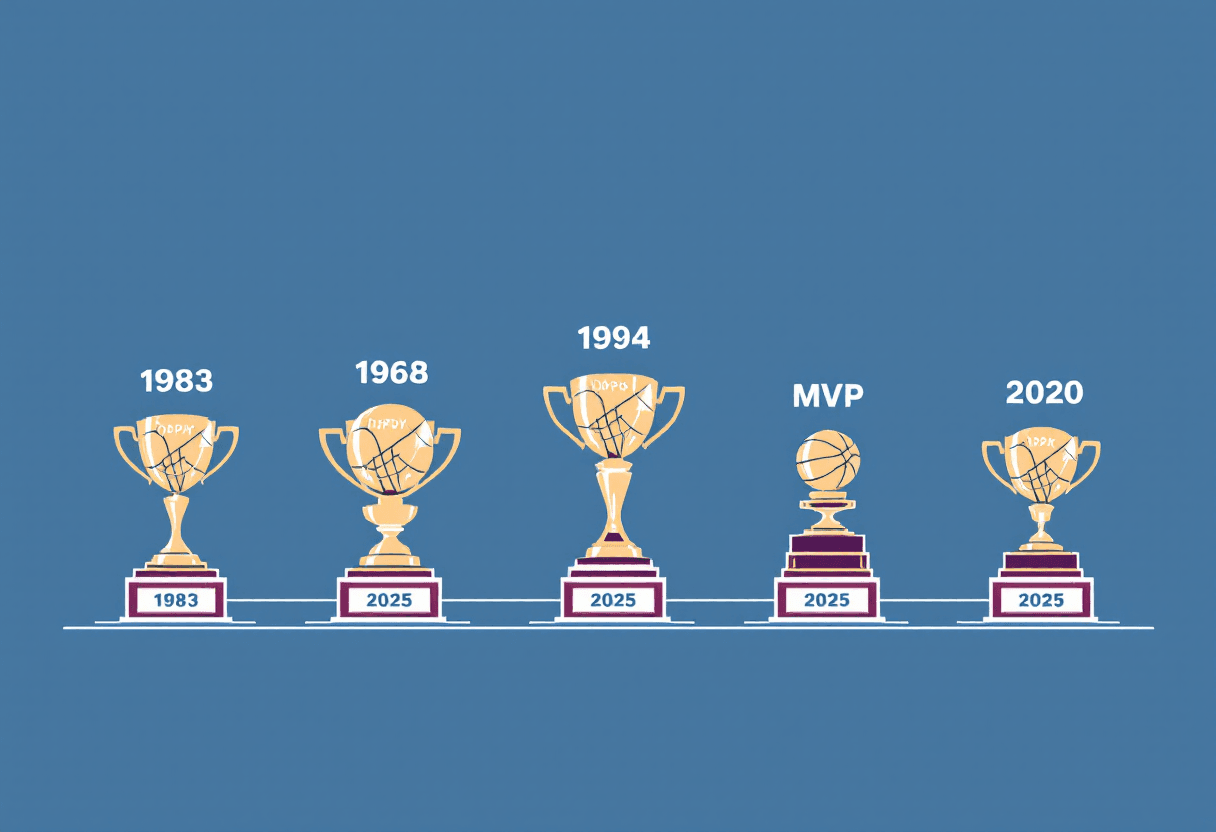
The NBA hands out two regular-season trophies that try to answer different questions. The Most Valuable Player award goes to the player who lifted his team most by what he did with the ball. The Defensive Player of the Year goes to the player who hurt the other team most when his team didn't have it. The awards have existed alongside each other since 1982–83, which is forty-three seasons of crowning ceremonies. In all that time, only three players have walked away with both trophies in the same year: Michael Jordan in 1987–88, Hakeem Olajuwon in 1993–94, and Giannis Antetokounmpo in 2019–20. That is the entire list. Every other elite two-way player in modern NBA history — Tim Duncan, Kevin Garnett, LeBron James, Kawhi Leonard, Anthony Davis — finished close on at least one ballot without ever finishing on top of both in the same calendar.
The rarity is structural. To win MVP, you usually have to be the best player on a top-three team and lead, or come close to leading, the league in counting stats voters can't argue with. To win DPOY in the modern game, you usually have to anchor a top-five defense as the recognizable centerpiece — the rim protector or perimeter terror that opposing offenses plan around. Doing both jobs at the same time is hard enough. Convincing the same voting bloc that one player tilts both ends of a game, in the same season, against the rest of the league's specialists, is harder still. The names below are the only three players who pulled it off.

The DPOY Award Before the Doubles
Before the three doubles, it helps to know what the DPOY was when it started. The award debuted in 1982–83, and the first winner was Sidney Moncrief of the Milwaukee Bucks — a 6'3" guard who treated isolation possessions like a personal insult. Moncrief repeated in 1983–84, becoming the award's first back-to-back winner. The early winners' list reads like a hall of perimeter terrors and rim deterrents: Mark Eaton (1985, 1989), Alvin Robertson (1986), Michael Cooper (1987). Voters spent the early years sketching out what "defensive value" was even supposed to mean before the position-specific consensus settled around centers and athletic forwards. By 1987–88 — the sixth year of the award — the trophy had been won by four different players. That's the context for what Michael Jordan did next.
Michael Jordan, 1987–88 Chicago Bulls
Jordan's MVP/DPOY season is the only one of the three doubles where the player won the scoring title in the same year. He averaged 35.0 points per game, leading the league for the second of what would become ten scoring titles, and he also led the NBA in steals at 3.16 per game. Add in 5.5 rebounds and 5.9 assists, and the box score reads less like a guard and more like the entire offense and most of the defense compressed into one body. He played all 82 games. The Bulls went 50–32 — a 10-win improvement over the previous season — and finished third in the Eastern Conference.
What made the DPOY case unusual for a guard wasn't the steals number, although 3.16 per game still ranks among the highest single-season averages in league history. It was that Jordan was the best help defender in his own conference at his size, paired with a coaching staff under Doug Collins (and a young assistant named Phil Jackson) that built a pressure-based defensive system around him. He averaged 1.6 blocks per game as a 6'6" shooting guard. He was named to the All-Defensive First Team for the first of nine consecutive seasons. The combination — best scorer in the league, best perimeter defender in the league, anchor of a playoff team — made the MVP/DPOY pairing feel inevitable in hindsight even as it was breaking new ground.
The Jordan double has aged into mythology. It is also the only one of the three that has attracted modern statistical re-examination. Recent research has flagged a substantial home-versus-road split in Jordan's 1987–88 steal and block numbers, suggesting Chicago Stadium's official scorers may have been generous to the hometown star — a phenomenon that wasn't unique to Chicago in the era but landed on the year that crowned him DPOY. The discourse around it doesn't strip Jordan of the trophy. It does add a footnote to the most decorated single season any guard has ever produced. No perimeter player before or since has won DPOY while averaging 30 points a night. The closest anyone has come is Jordan himself — and he averaged 35.
Hakeem Olajuwon, 1993–94 Houston Rockets
If Jordan's double was the league's first proof of concept, Hakeem's was the culmination of what the award was originally built to recognize. Olajuwon averaged 27.3 points, 11.9 rebounds, 3.6 assists, 1.6 steals, and 3.7 blocks per game on his way to leading the Houston Rockets to a 58–24 record and the second seed in the Western Conference. He led the league in blocks. He was first-team All-NBA and first-team All-Defense. He was 31 years old, in his tenth NBA season, finally surrounded by a roster that could keep him out of double teams long enough for the rest of the league to watch what he did with a clean look.
The 1993–94 season is the only MVP/DPOY year that also produced a championship and a Finals MVP. Olajuwon beat the Phoenix Suns in seven, the Jazz in five, then went the distance with Patrick Ewing's Knicks in a Finals that ended on a seventh-game home win at the Summit. He averaged 26.9 points, 9.1 rebounds, 3.6 assists, and 3.9 blocks across the Finals series and was named Finals MVP by a unanimous vote. That season made him the first — and to date only — player in NBA history to collect MVP, Defensive Player of the Year, Finals MVP, and an NBA championship in the same year.
What makes the season hold up so well in retrospect is the timing. The 1993–94 NBA was post-Showtime, mid-Jordan-baseball-sabbatical, pre-Shaq-relocation, and shaped by physical center play in ways the modern game has largely written out. Olajuwon's "Dream Shake" — a footwork sequence borrowed from his Nigerian soccer background — defined a generation of post players, and 1993–94 was the year it ate every defender the West could send at him. The defensive side of his case wasn't a counting-stat case alone. The Rockets were a top-five defense with Hakeem on the floor and a bottom-half defense without him. The same player anchoring both ends of the floor for a championship team is the cleanest single-season résumé in this entire conversation.
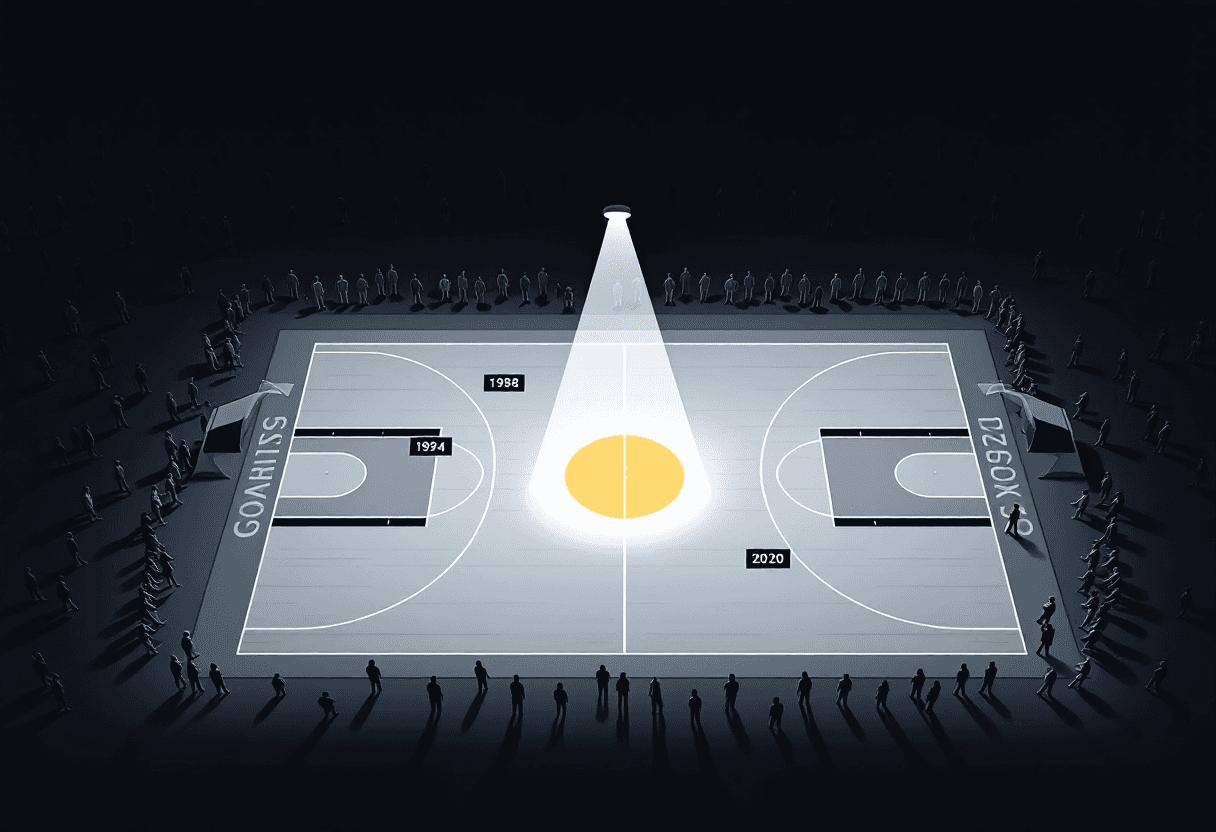
Giannis Antetokounmpo, 2019–20 Milwaukee Bucks
The third double came twenty-six years after Hakeem's. Giannis Antetokounmpo had already won MVP in 2018–19 and arrived at the 2019–20 season as the consensus best player in the conference. He averaged 29.5 points, 13.6 rebounds, and 5.6 assists per game while leading the Bucks to a 56–17 record — the best record in the NBA when the season was paused for COVID-19 in March 2020. The Bucks had the league's best defense by a wide margin, and Antetokounmpo was the engine: a 6'11" wing who could switch onto a point guard, recover to a corner shooter, contest at the rim, and start the break the other way without subbing out.
The DPOY voting was a landslide. Giannis received 75 of 100 first-place votes, with Anthony Davis a distant second. His traditional defensive counting stats — 1.0 blocks and 1.0 steals per game — looked modest, but the impact stats were dominant: a 97.4 defensive rating, the league's highest defensive win-share total at 5.0, and a 36.9% opponent field-goal percentage when he was the primary defender, the lowest of any player with at least 40 games. The Bucks' defense fell off a cliff when he left the floor. The MVP came a few months later. He won that by a comfortable margin over LeBron James, becoming the third back-to-back MVP since the merger and the first to pair his back-to-back with a DPOY.
The 2019–20 season is the only one of the three where the player was not a finished product. Hakeem was 31; Jordan was 24 but already a six-year veteran and a four-time MVP runner-up in waiting; Giannis was 25 and still being asked to develop a jump shot. The defensive piece of his game had outpaced the offensive piece — a fact that has shaped Bucks roster construction for the years since. The award voting that season also marked a turning point for what DPOY could look like. Anchoring rim protection through positionless switching, rather than from a stationary center spot, is the modern blueprint, and Giannis was the first MVP/DPOY winner to fit that profile.
The Players Who Came Closest
Outside those three names, the list of near-misses is long enough to fill an article of its own. Tim Duncan is the canonical example. He won two MVPs (2001–02 and 2002–03), was named to the All-Defensive First or Second Team in 15 of his 19 NBA seasons, and never finished higher than third in DPOY voting (in both 2000–01 and 2006–07). The conventional wisdom is that voters split his case with his Spurs teammate Bruce Bowen and were reluctant to award the same player both trophies in years he was an MVP front-runner. Duncan was the league's best two-way player for almost a decade; the awards file simply didn't say so.
Kevin Garnett's case is the most often miscredited. Garnett won MVP in 2003–04 with the Minnesota Timberwolves, averaging 24.2 points, 13.9 rebounds, and 5.0 assists, and he finished third in DPOY voting that year behind eventual winner Ron Artest of the Pacers. Garnett didn't win DPOY until four seasons later, in 2007–08, when he had moved to the Boston Celtics, anchored the league's best defense, and won the championship — but by then his MVP campaigns were behind him. So Garnett collected both trophies during his career, but never in the same season. That distinction matters: a "career MVP and DPOY" club exists with more members than the single-season club, and Garnett is the textbook example of how the same player can be the league's best on both ends across his prime without ever being awarded both in the same calendar.
LeBron James spent the heart of his Miami Heat run lobbying the voters in the same direction. In 2012–13, he won MVP with 120 of 121 first-place votes — one short of unanimous — and finished second in DPOY voting behind Marc Gasol. The voting was close enough that LeBron has publicly argued, years later, that he should have won the DPOY. He was first-team All-Defense that season; Gasol wasn't. In 2008–09, his first MVP year, LeBron finished second in DPOY voting behind Dwight Howard, but the margin was decisive (105 first-place votes to four). Neither year produced the double, and LeBron has never finished higher than second on a DPOY ballot.
Kawhi Leonard, the rare wing two-time DPOY winner (2014–15 and 2015–16), finished as high as second in MVP voting in 2015–16 but never paired both. Anthony Davis was the runner-up to Giannis in 2019–20 DPOY voting and a top-five MVP candidate that same year — the closest any non-winner has come in the modern game. Joel Embiid, the 2022–23 MVP, finished tied for ninth in DPOY voting that season. The pattern is consistent: the closest a star ever gets is one of the two awards plus a top-five finish in the other, with someone else carrying the second trophy home.
Why the Double Has Become Rarer
The modern NBA is structured against the MVP/DPOY pairing in a few specific ways. The defensive specialist class has hardened. A player whose only job is to anchor a top-three defense — Rudy Gobert across four of his DPOY wins, Marc Gasol in 2012–13, Tyson Chandler in 2011–12 — will almost always beat a high-usage star at the same position on the ballot. Voters tend to reward the player who is more identifiably "defensive" first, even if a star is producing the same impact at higher usage. The MVP race is now a usage-heavy contest. The top of the leaderboard for assist rate, usage rate, and scoring volume sits with point guards and combo wings whose defensive case is rarely strong enough to crack the top three for DPOY. And voting blocs have become more careful about double-awarding. The post-2017 awards ceremony format, the rise of social media voting tracking, and the league's separation of MVP and DPOY into different broadcast windows have all made it less likely that the same player gets crowned twice on the same night.
There is also a fourth, simpler reason. It is just very, very hard to do. Jordan is the only guard who has won DPOY since 1987. Hakeem and Giannis are two of only a handful of frontcourt players in any era who could lead their team in points, rebounds, and impact-adjusted defensive metrics simultaneously. The next MVP/DPOY winner will need a similar combination — a player whose offense is league-leading enough to clear the MVP field and whose defensive case is loud enough to outpace a generation of specialists. Victor Wembanyama already has one DPOY trophy on his shelf, with an MVP race in his medium-term future. Giannis himself is still active and still a defensive candidate. The doors are not closed. They are just opening one notch at a time.
What These Seasons Have in Common
Read the three doubles end-to-end and three things stand out. Every one of them happened on a team that won at least 50 games. Voters have never given the double to a player whose team finished below playoff caliber, regardless of how dominant the individual numbers were. Each player led his team in scoring, rebounding (for the big men), and either steals or blocks in the same season. The MVP/DPOY winner is not a specialist on either end. He is the single most productive player on both. And every one of them was the most identifiable face of the league or his conference that year. Jordan in 1988 was the most-watched player in the NBA. Hakeem in 1994 was a Finals MVP, a championship anchor, and the dominant story of the Jordan-less post-season. Giannis in 2020 was the back-to-back MVP. Awards voting rewards visibility as much as production, and these three seasons paired visibility with the kind of two-way résumé that voters could not honestly split.
The MVP/DPOY double will probably happen again. It will probably not happen often. Between now and the next time it does, the three names above will continue to define what an NBA player can do across both ends of the floor in a single 82-game stretch. Forty-three seasons. Three winners. The trophy room is unusually clean.
Related Reading
- The NBA's Greatest Defensive Players of All Time
- NBA Awards History: MVPs, DPOYs, and More
- The Most Controversial MVP Races in NBA History
- Michael Jordan vs Tim Duncan: Comparing Two Different GOATs
Names like these — and the years they did it — show up constantly in NBA awards trivia. Test your award-history recall with our daily Who Am I? quiz, where the mystery players hide behind clues that span MVP races, DPOY ladders, and every Finals run in between. And if you want to stack your knowledge of the all-time greats across every category, our NBA Bingo board pulls from every era of league history.