
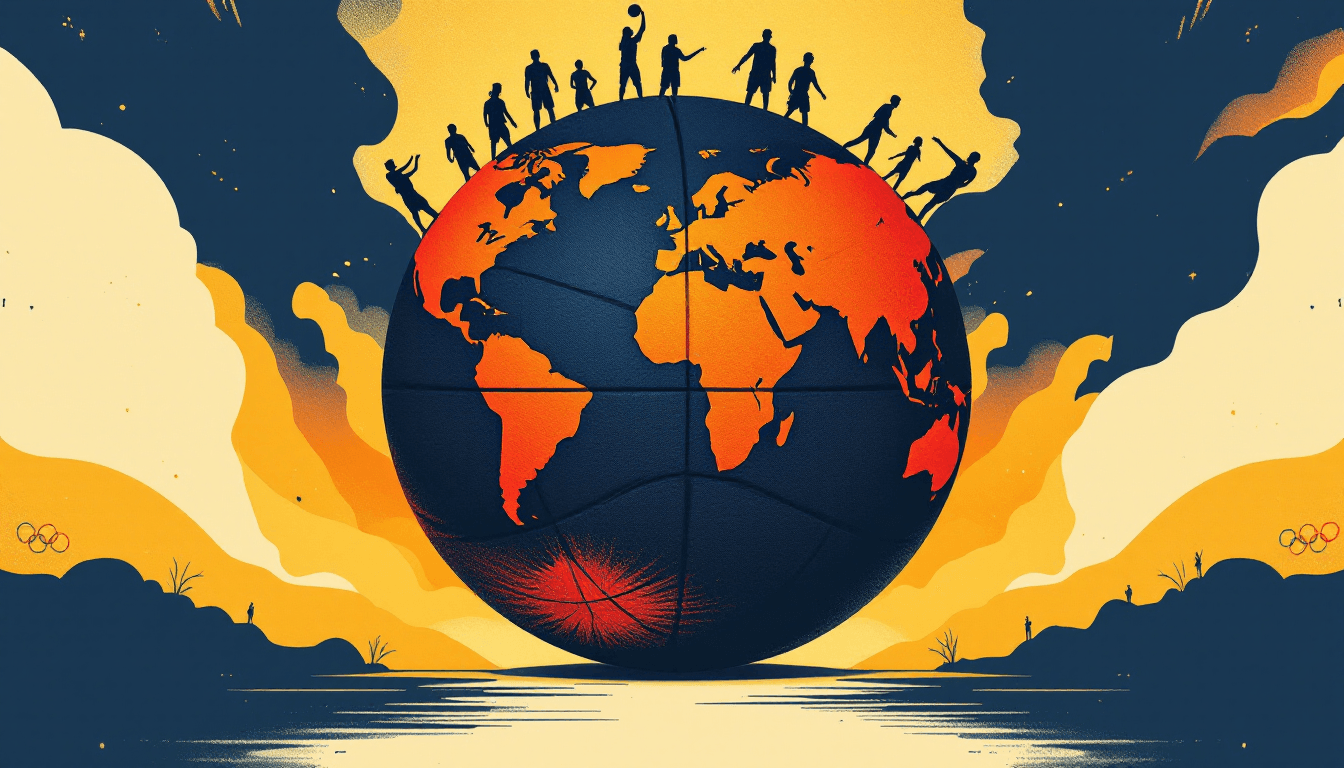
The NBA was once an almost exclusively American league. In 1992, just 23 international players from 18 countries suited up across the entire league. By the 2025-26 season, that number had climbed to a record 135 players from 43 countries across six continents. International players don't just fill roster spots anymore — they win MVPs, lead franchises, and define entire eras. Eight consecutive NBA MVP awards, from 2019 through 2026, went to players born outside the United States: Giannis twice, Jokić three times, Embiid once, then Shai Gilgeous-Alexander twice. Understanding how the NBA got here means going back to the game's pre-global roots, through the moment that changed everything, and forward to the wave of talent that followed.
The Pioneers: Yugoslavia Before the Flood
Before the globalization conversation existed, a handful of European players were quietly proving that the NBA's borders were arbitrary. Vlade Divac and Dražen Petrović — both from Yugoslavia — arrived in the NBA in 1989 and became the first two international players to achieve genuine NBA stardom. Divac played 16 seasons and finished with 13,000 points, 9,000 rebounds, 3,000 assists, and 1,500 blocks — a grouping shared only with Kareem Abdul-Jabbar, Tim Duncan, Shaquille O'Neal, Kevin Garnett, and Hakeem Olajuwon. Petrović, who blossomed with the New Jersey Nets after an initial stint in Portland, averaged 21.4 points in his final two NBA seasons before his death in a 1993 car accident. His shooting and creation skills anticipated the kind of European guard play that would eventually transform the league's offensive philosophy. Both players arrived before the NBA had meaningful international scouting infrastructure and changed the template for what a foreign-born player could become.
Hakeem Olajuwon — The First Great International Star
The argument for Hakeem Olajuwon as the foundational international NBA player isn't just about his numbers — it's about what those numbers meant in context. Born in Lagos, Nigeria, Olajuwon was drafted first overall by the Houston Rockets in 1984, in a class that also included Michael Jordan at #3, Charles Barkley at #5, and John Stockton at #16. He finished his career averaging 21.8 points, 11.1 rebounds, and 3.1 blocks across 1,238 games — winning two NBA championships, the 1994 MVP, and back-to-back Defensive Player of the Year awards in 1993 and 1994. He remains the only player in NBA history to win league MVP, DPOY, and Finals MVP in the same season. His 1994 playoff run — dismantling David Robinson, then Patrick Ewing's Knicks, with a footwork vocabulary that had no American analogue — was a proof of concept: a player who learned basketball in Lagos, who had played soccer and handball as a teenager, could become the best player alive.
The Dream Team Effect: Barcelona 1992
Nothing accelerated the globalization of basketball more than the 1992 United States Olympic team. Before Barcelona, the NBA had 23 international players from 18 countries. The Dream Team — Jordan, Magic, Bird, Barkley, Ewing, Malone, Pippen, Stockton, Drexler, Mullin, Robinson, and Laettner — won their eight games by an average of 44 points and were mobbed by opposing players seeking autographs. A 13-year-old Dirk Nowitzki in Würzburg, an 11-year-old Pau Gasol in Barcelona, and a young Manu Ginobili in Bahía Blanca all watched those games and decided they too could play at that level. The effect wasn't just inspirational — it was infrastructural. International broadcasters invested in NBA rights; China's CCTV covered the NBA All-Star Game for the first time in 1994. The game went global in both directions simultaneously: the Dream Team evangelized basketball to millions of new fans, and those fans produced the next generation of players who eventually came back to dominate the league that inspired them.
Dirk Nowitzki — Rewriting the Big Man Position
Dirk Nowitzki didn't just become a great NBA player. He invalidated decades of conventional wisdom about what a power forward was supposed to do. Born in Würzburg, Germany, Nowitzki was drafted 9th overall by Milwaukee in 1998 and immediately traded to Dallas. Before Dirk, big men posted up, rebounded, and protected the rim. They weren't supposed to drift to the three-point line or execute one-legged fadeaways over smaller defenders who couldn't contest them. Nowitzki did all of it across 1,522 games — career averages of 20.7 points, 7.5 rebounds, 38.0% from three, 87.9% from the line. He won the 2007 MVP, the first European to receive the award. He won the 2011 championship as Finals MVP, averaging 26 points per game with 10.3 in the fourth quarter against LeBron, Wade, and Bosh. Every stretch four and floor-spacing center in the modern NBA traces a philosophical line back to what Dirk proved was possible in a 7-foot body.
Manu Ginobili and Argentina's Gold
Manu Ginobili is remembered as a San Antonio Spur — four NBA championships, Hall of Famer. What sometimes gets lost is that he was simultaneously building one of the most remarkable international careers in basketball history. At the 2004 Athens Olympics, Ginobili scored 29 points on 9-of-13 shooting to lead Argentina past a United States team that included LeBron James, Dwyane Wade, Carmelo Anthony, and Allen Iverson, 89-81, in the semifinals. Argentina won gold — the first team other than the United States to do so in 16 years — and Ginobili was named tournament MVP. His Eurostep, a two-step drive move developed in European basketball that American defenders hadn't seen in the rhythm they expected, became one of the most imitated moves in the NBA and reshaped how guards attacked paint defense. The 2004 gold medal was a watershed: it proved the gap between Team USA and the rest of the world had closed.
Steve Nash and Canada's Quiet Emergence
Before Shai Gilgeous-Alexander, before Jamal Murray, Canada's entire NBA legacy ran through one player. Steve Nash, born in South Africa and raised in British Columbia, won back-to-back MVP awards in 2005 and 2006 — the first Canadian ever to win the award and just the second point guard after Magic Johnson to win multiple MVPs. His Phoenix Suns teams introduced the seven-seconds-or-less system that reshaped how the league thought about pace and spacing. Nash averaged double-digit assists for seven consecutive seasons and shot above 50% from the field for 10 straight. He was a forerunner — proof that players developed outside the American pipeline could reach the game's highest individual level. The Canadian pipeline he inspired now produces 21 NBA players per season, more than any country except the United States and France.

Yao Ming and the China Opening
No single player opened a market the way Yao Ming opened China. Selected first overall by the Houston Rockets in the 2002 NBA Draft — the first international player ever taken first overall without having played U.S. college basketball — Yao was 7-foot-6, already a veteran of the Chinese Basketball Association, and immediately one of the most recognizable athletes on the planet. He averaged 13.5 points and 8.2 rebounds as a rookie, was voted an All-Star starter in 2003, and made seven consecutive All-Star appearances. His career averages of 19.0 points and 9.2 rebounds were cut short by foot injuries at 30. But the cultural impact exceeded the statistical one. Chinese television ratings for Rockets games became extraordinary, the NBA opened an official China office, and the league's China business — rights, merchandise, sponsorships — was eventually worth billions. Yao demonstrated that international players weren't just an on-court asset; they were the mechanism through which the NBA could grow its global business model in ways no domestic player could match.
Tony Parker — The First European Finals MVP
Tony Parker arrived in San Antonio as the 28th pick in the 2001 NBA Draft, a French teenager who had never played American college basketball. He became the Spurs' starting point guard as a 19-year-old and led San Antonio in assists and steals that rookie season, earning All-Rookie First Team honors as the first foreign-born guard to do so. He won four NBA championships with the Spurs (2003, 2005, 2007, 2014) and was named Finals MVP in 2007 — the first European player ever to receive that honor. Parker's floater in the lane and his change-of-pace game were built in French youth basketball before American defenders had specific counters for them. His career is the template that European guards still follow: develop complete decision-making in professional leagues overseas, then arrive in the NBA already ahead of the adjustment curve.
Pau Gasol and the Spanish Wave
Pau Gasol was the third overall pick in the 2001 NBA Draft — drafted by Atlanta and immediately traded to the Vancouver Grizzlies — and won the NBA Rookie of the Year award in 2002, becoming the first non-American to win that award. He went on to win two NBA championships with the Los Angeles Lakers (2009 and 2010), appearing in six All-Star Games across an 18-season career. Gasol's arrival was part of a broader Spanish explosion: his brother Marc became a three-time All-Star and 2013 Defensive Player of the Year; Ricky Rubio became a first-round pick and starting point guard across multiple franchises. Spain's national system — club academies that developed technical skill from childhood, the ACB league — produced a generation of players with passing, footwork, and positional IQ that translated immediately to the NBA.
Giannis Antetokounmpo — From Athens to the Top
The arc of Giannis Antetokounmpo's career is the most dramatic in the NBA's international era. Born in Athens to Nigerian immigrant parents, Giannis was drafted 15th overall by the Milwaukee Bucks in 2013 — a class that also produced Victor Oladipo at #2 and CJ McCollum at #10 — as an 18-year-old who had barely played organized basketball. By his sixth season he was an MVP. He won back-to-back MVP awards in 2019 and 2020, and in 2021 led Milwaukee to its first championship in 50 years — scoring 50 points, grabbing 14 rebounds, and adding 5 blocks in the series-clinching Game 6 against the Phoenix Suns. His development from raw teenager to the league's most dominant force, with the same franchise, across a decade — without the superteam shortcuts that defined his era — represents the highest possible return on an international scouting decision.
Nikola Jokić — The Lowest Pick to Become the Best Player
Nikola Jokić was the 41st pick in the 2014 NBA Draft. He fell that far because he was overweight, played in a second-tier Serbian league, and passed rather than scored in a position where the conventional instinct was to demand the ball and create your own shot. The Nuggets saw a center who could run an offense the way a point guard would. The results were unprecedented. Jokić won three MVP awards (2020-21, 2021-22, and 2023-24) and led Denver to their first-ever NBA championship in 2023, posting Finals averages of 30.2 points, 14.0 rebounds, and 7.2 assists to win Finals MVP unanimously — the lowest-drafted player in NBA history to do so. His passing volume and decision-making from the five position has influenced how teams across the league think about deploying a dominant big man. Jokić is from Sombor, Serbia, a city of 50,000, and he is the best passer the NBA has ever seen at his position.
Luka Dončić and the New European Standard
Luka Dončić arrived in the NBA as the most accomplished young player to enter the draft in the league's history — measured by professional achievement, not potential. At 19, playing for Real Madrid, he became the youngest MVP in EuroLeague history, winning both the regular-season MVP and the Final Four MVP before his NBA debut. He was drafted 3rd overall in 2018 by Atlanta and immediately traded to Dallas, and was a first-team All-NBA selection within two seasons. His combination of size, skill, and basketball IQ was fully formed before he stepped on an NBA floor — the product of professional coaching since age 13. Dončić is the clearest proof that the European pathway can produce players who arrive NBA-ready rather than requiring a multi-year adjustment.
The Streak That Defines the Modern Era
From 2019 through 2026, every NBA MVP was born outside the United States: Giannis Antetokounmpo (Greece, 2019 and 2020), Nikola Jokić (Serbia, 2021, 2022, and 2024), Joel Embiid (Cameroon, 2023), and Shai Gilgeous-Alexander (Canada, 2025 and 2026) — eight consecutive awards. Gilgeous-Alexander's back-to-back wins made him the second Canadian to win MVP, following Nash, and the 14th player to win consecutively. The streak reflects structural advantages that international pathways have built over two decades: longer windows of professional coaching, greater emphasis on skill over athleticism. The 135 international players on 2025-26 rosters came from 43 countries; all 30 teams fielded at least one. Canada led with 21 players, France with 14. The league that had 23 international players in 1992 now draws from professional leagues on six continents — and the best players from that pool have been the best players in the NBA for nearly a decade.
What Globalization Actually Changed
The cliché version of the NBA's international story is purely additive: more players from more countries made the league better. The real story is more structural. European basketball's emphasis on passing, spacing, and off-ball movement changed how NBA offenses were designed — the center-as-playmaker concepts and five-out spacing that define modern basketball were accelerated by players trained in European systems. The willingness of front offices to trust foreign-league signals changed how prospects were evaluated: Jokić at 41st, Giannis at 15th, Dončić traded up for. The commercial footprint grew in parallel — the NBA's international rights and sponsorship business is directly tied to players like Yao, Dirk, Giannis, and Luka giving markets from Munich to Manila a reason to watch. The NBA didn't just get better because of international players. It got bigger. Both things happened inseparably, beginning with the night in Barcelona when 12 Americans taught the world basketball was worth caring about — and the world responded by producing the players who now run the league.

Related Reading
- The 1992 Dream Team: The Greatest Basketball Team Ever Assembled
- The Most Controversial MVP Races in NBA History
- NBA Awards History: MVPs, DPOYs, and More
- NBA Rookies Who Changed the Game Immediately
The players who built the NBA's global era — from Olajuwon to Giannis to Jokić — show up constantly in basketball trivia. Test your knowledge of their nationalities, draft slots, and career milestones in our daily Who Am I? quiz, or take on the international player categories that appear regularly in Connections.