
The fastest way to find the holes in your NBA knowledge is to sort it by decade. Most fans are strong in the era they grew up watching and shaky everywhere else — a 2010s die-hard might know every Warriors lineup but draw a blank on who guaranteed a championship sweep in 1983. These NBA trivia questions are organized into four rounds, one per decade from the 1980s through the 2010s, so you can see exactly where your timeline gets thin. Each round captures the defining dynasties, the signature single-game moments, and the award winners that anchor that ten-year stretch. Every answer is verified against the record books. Work through all four and you'll have a clean map of modern NBA history — and a much better sense of which decade you actually need to study.
Why Sorting Trivia by Decade Works
Basketball history isn't a flat list of facts — it's a sequence of eras, each with its own dominant team, its own rule changes, and its own style of play. The 1980s were about two coastal dynasties and a rivalry that saved the league. The 1990s belonged to one man and the contenders who kept losing to him. The 2000s fractured into multiple champions and the rise of international stars. The 2010s were the decade of the super-team and the three-point explosion. Anchoring trivia to those narratives makes it stick: instead of memorizing that Hakeem Olajuwon won titles in 1994 and 1995, you remember why — Jordan was off playing baseball. Below, each decade gets its own round. Keep score per round, and the weak one will announce itself.
Round 1: 1980s NBA Trivia
The decade of Showtime, the Celtics-Lakers rivalry, and a young guard out of North Carolina.
1. Which franchise won the most NBA championships in the 1980s? The Los Angeles Lakers, with five — in 1980, 1982, 1985, 1987, and 1988. Built around Magic Johnson and Kareem Abdul-Jabbar, the "Showtime" Lakers reached the Finals eight times in the decade. Their 1987–88 repeat made them the first team to go back-to-back since the Celtics in 1968–69.
2. Who won the NBA Rookie of the Year award in 1985? Michael Jordan, who averaged 28.2 points as a rookie and dragged the Bulls back into the playoffs. He led Chicago in points, rebounds, assists, and steals — the only rookie ever to top his team in all four.
3. Which player guaranteed a title with the prediction "Fo', Fo', Fo'" in 1983? Moses Malone, before leading the Philadelphia 76ers on a 12–1 playoff run. His forecast of three straight sweeps was nearly perfect — they dropped just one game — and the Sixers finished it by sweeping the Lakers in the Finals.
4. Who won three consecutive MVP awards from 1984 to 1986? Larry Bird, the first non-center in NBA history to win three in a row. His Celtics traded Finals trips with Magic's Lakers throughout the decade.
5. Magic Johnson won Finals MVP as a 20-year-old rookie in 1980 — at what position did he start the clinching game? Center. With an injured Kareem Abdul-Jabbar out for Game 6, Magic jumped to center and posted 42 points, 15 rebounds, and 7 assists to win the title.
6. Which player broke the NBA's all-time scoring record in 1984? Kareem Abdul-Jabbar, who passed Wilt Chamberlain on April 5, 1984. His record stood for nearly four decades until LeBron James broke it in 2023.
Round 2: 1990s NBA Trivia
Jordan's Bulls, the contenders who couldn't get past them, and the two years he stepped away.
7. Which player led his team to back-to-back titles in 1994 and 1995, while Michael Jordan was retired? Hakeem Olajuwon, whose Houston Rockets beat the Knicks in seven games in 1994, then swept a young Shaquille O'Neal and the Magic in 1995. In 1994 he won MVP, Finals MVP, Defensive Player of the Year, and the title — all in one season, a sweep of major awards no one else has matched. The 1995 repeat came after a midseason trade reunited him with his college teammate Clyde Drexler.
8. Who scored 71 points on the final day of the 1994 season to steal the scoring title from Shaquille O'Neal? David Robinson. Trailing Shaq by a sliver of a point in the per-game race, the Spurs fed Robinson all night and he erupted for 71 to finish at 29.8 per game.
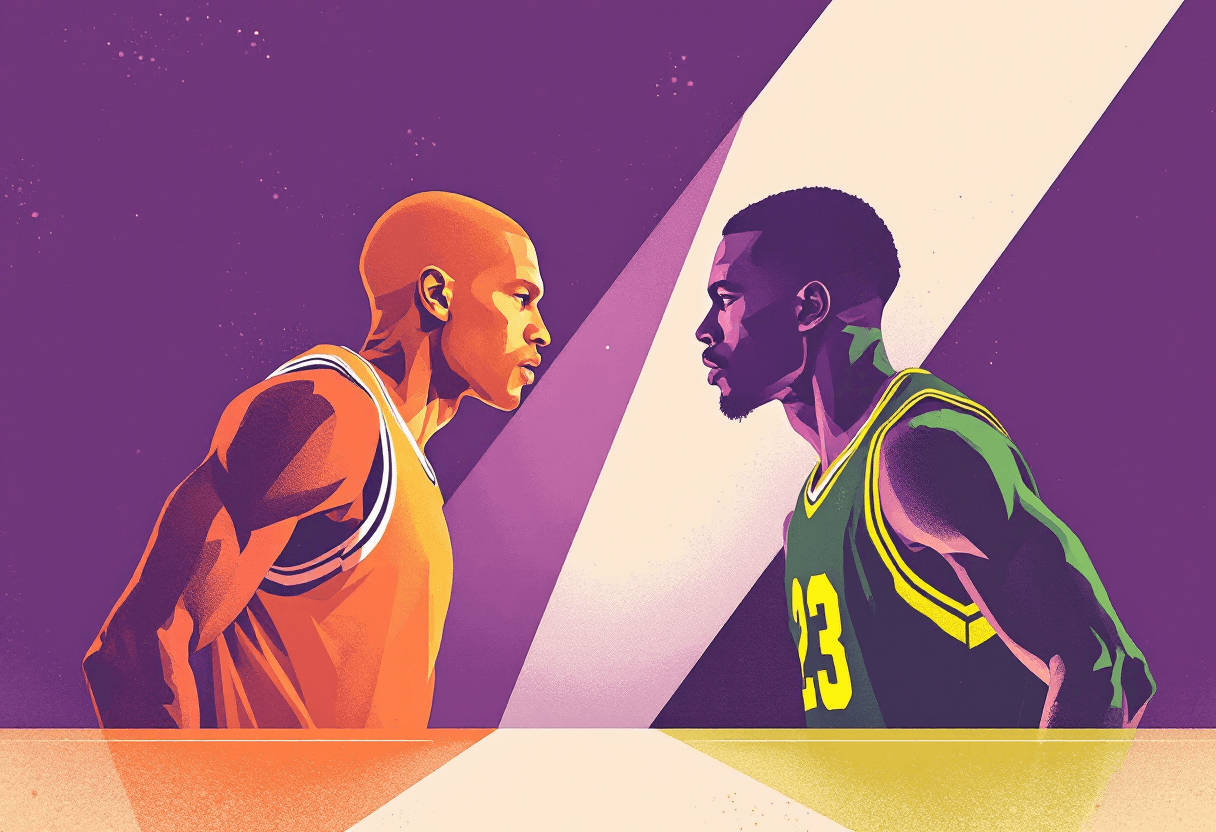
9. Who scored 8 points in 9 seconds to beat the Knicks in the 1995 playoffs? Reggie Miller, in Game 1 of the Eastern Conference Semifinals at Madison Square Garden. Down six in the final seconds, Miller hit two threes around a steal to flip a sure loss into a 107–105 Pacers win.
10. Which two players shared the 1995 Rookie of the Year award? Grant Hill and Jason Kidd, in one of the closest votes in award history. Hill became the first rookie ever to lead All-Star fan balloting; the tie surprised everyone, Hill included.
11. Who was the first overall pick in the 1996 NBA Draft and the 2001 MVP? Allen Iverson, taken #1 by the Philadelphia 76ers out of Georgetown. In his 2001 MVP season he averaged 31.1 points and carried Philadelphia to the Finals.
12. How many championships did Michael Jordan's Bulls win in the 1990s? Six — two separate three-peats, in 1991–93 and 1996–98. Jordan was Finals MVP in all six.
Round 3: 2000s NBA Trivia
Three-peats, the first European MVP, and the comebacks that defined the decade.
13. Which guard won back-to-back MVP awards in 2005 and 2006? Steve Nash, running the "Seven Seconds or Less" Phoenix Suns. He was the first point guard to win consecutive MVPs since Magic Johnson, leading the league in assists both years — and the first Canadian ever to win the award. His first MVP win came after he lifted the Suns from 29 wins to 62 in a single season.
14. Who scored 13 points in 33 seconds to beat the Spurs in December 2004? Tracy McGrady, whose Rockets trailed by eight with 35 seconds left. He drained four three-pointers — one a four-point play — and the game-winner with two seconds left for an 81–80 win.
15. Which "Big Three" won the 2008 title, and who was Finals MVP? The Boston Celtics' trio of Paul Pierce, Kevin Garnett, and Ray Allen, assembled the previous offseason. They beat the Lakers in six for Boston's 17th title, with Pierce named Finals MVP. The new core turned a 24-win team into a 66-win champion — a 42-game swing in a single season.
16. Who became the first European player to win NBA MVP, in 2007? Dirk Nowitzki of the Dallas Mavericks — though his MVP season ended in a stunning first-round upset by the eighth-seeded Warriors.
17. Which team three-peated as champions from 2000 to 2002? The Los Angeles Lakers, led by Shaquille O'Neal and Kobe Bryant. O'Neal was named Finals MVP all three years.
18. Which player was the 2001 MVP and led the 76ers to the Finals? Allen Iverson, at just 6 feet tall — one of the smallest MVPs ever, and the engine of a Philadelphia team that reached the championship round against the three-peating Lakers.
Round 4: 2010s NBA Trivia
Super-teams, the three-point revolution, and a farewell for the ages.
19. Who won Finals MVP with two different teams, in 2014 and 2019? Kawhi Leonard — with the San Antonio Spurs in 2014, then the Toronto Raptors in 2019. He's the only player to win Finals MVP with teams from both conferences, and one of just three to win it with multiple franchises, alongside Kareem Abdul-Jabbar and LeBron James.
20. Who scored 60 points in his final NBA game in 2016? Kobe Bryant, capping 20 seasons spent entirely with the Lakers in a 101–96 win over the Jazz on April 13, 2016. He took 50 shots and scored 23 in the fourth quarter, rallying Los Angeles from a 15-point deficit in his send-off.
21. Which team beat the heavily favored Miami Heat for the 2011 championship? The Dallas Mavericks, avenging their 2006 Finals loss. Dirk Nowitzki was named Finals MVP, capping the run despite playing Game 4 with a 101-degree fever.
22. Who won back-to-back MVP awards in 2019 and 2020? Giannis Antetokounmpo of the Milwaukee Bucks. In 2020 he also won Defensive Player of the Year — joining Michael Jordan and Hakeem Olajuwon as the only players to take both in one season.
23. Which two championships did LeBron James win with the Miami Heat? 2012 and 2013, earning Finals MVP both years. The back-to-back titles put him alongside Jordan and Bill Russell as the only players to win consecutive regular-season MVPs and titles.
24. Which team completed the first 3–1 comeback in NBA Finals history? The Cleveland Cavaliers, in 2016 — erasing a 3–1 deficit against the 73-win Golden State Warriors to deliver Cleveland its first championship and end a 52-year title drought for the city. LeBron James led both teams in points, rebounds, assists, steals, and blocks across the series.
What Each Decade Tells You
Lay the four rounds side by side and the shape of modern NBA history emerges. The 1980s were defined by two dynasties feeding off each other — the Lakers' five titles meant nothing without the Celtics to beat. The 1990s collapsed into a single gravitational center: Jordan won every Finals he reached, and the only championships that escaped him came in the two years he walked away. The 2000s were the most democratic decade, with the Lakers, Spurs, Pistons, Heat, and Celtics all raising banners, and the MVP award crossing the Atlantic for the first time. The 2010s were the decade of player movement — stars teaming up, winning rings on multiple rosters, and stretching the floor until the three-pointer became the sport's defining shot.
There's also a generational tell hidden in the scores. Fans who came up in the 1990s tend to ace Rounds 2 and 3 and stumble on the Showtime era; fans who started watching in the LeBron era often know every 2010s super-team but can't name the player who guaranteed "Fo', Fo', Fo'." Neither is a knowledge problem — it's a question of which highlights were already old by the time you tuned in. That's exactly why trivia framed by decade is the most efficient way to study: it surfaces the blind spot instead of letting it hide inside a giant undifferentiated pile of facts.
If one round tripped you up far more than the others, that's not really a gap in trivia knowledge so much as a gap in watching. The cure is the same either way: pick the decade you're weakest on, learn its dynasty, its rule changes, and its three or four signature moments, and the individual facts will hang themselves on that frame. The 1980s hang on Lakers-Celtics. The 1990s hang on Jordan. The 2000s hang on the Lakers and Spurs trading titles. The 2010s hang on player movement and the three-point line. History is always easier to remember as a story than as a list — and once you have the story, the trivia answers itself.
Related Reading
- NBA Trivia Questions and Answers (Easy to Hard)
- Hard NBA Trivia Questions That Stump Real Fans
- The 2016 Cavaliers 3-1 Comeback: The Greatest NBA Finals Rally Ever
- The 1992 Dream Team: The Greatest Basketball Team Ever Assembled
Knowing the decades cold is the foundation of every good trivia run. Put your era knowledge to the test with a fresh challenge every day on airball.gg — span every decade at once with our daily Who Am I? mystery-player quiz, or sort players from across NBA history into hidden groups in Connections.