
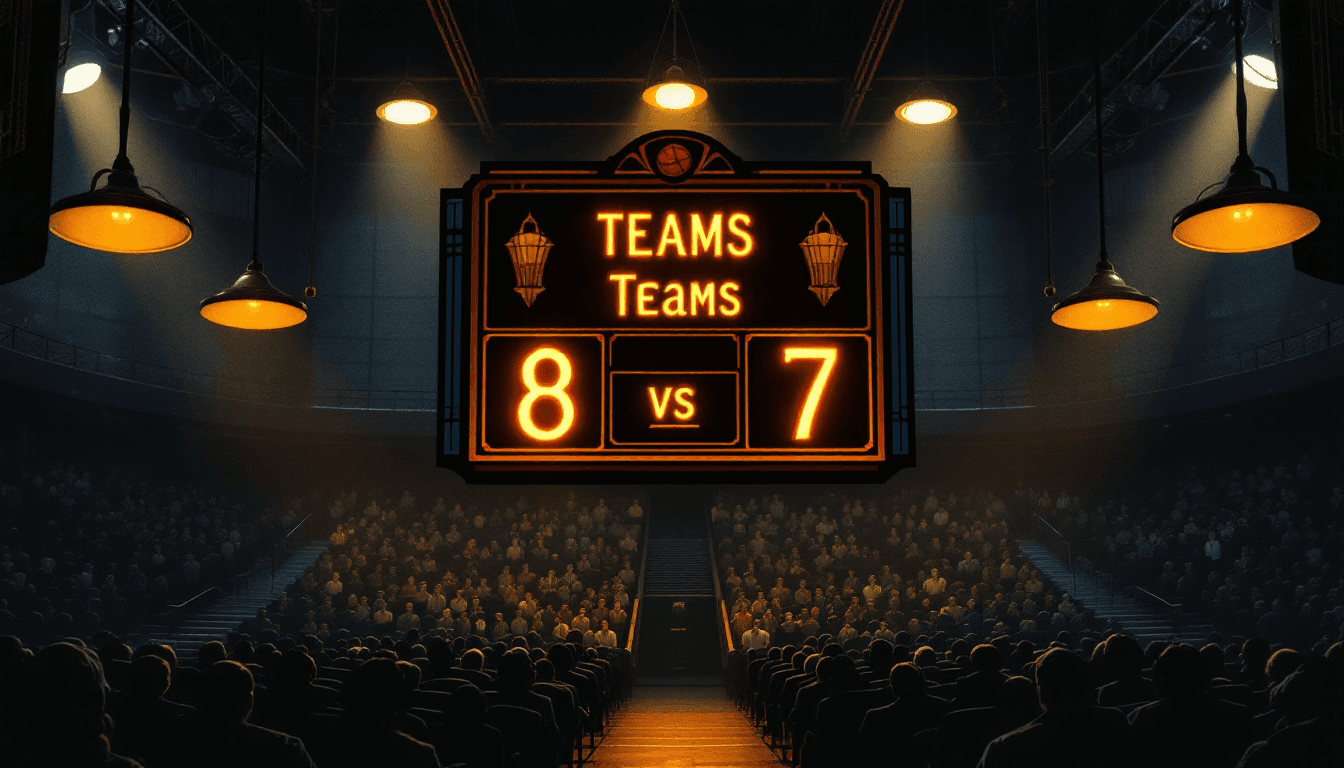
The lowest scoring quarter in NBA history happened on April 11, 2015, when the New York Knicks and the Orlando Magic combined for fifteen points across an entire twelve-minute period. The Magic scored seven, the Knicks scored eight — and that was it. Together, two professional basketball teams playing in a sport designed around scoring put the ball through the hoop a total of six times from the field in twelve minutes of action. The period still holds the Guinness World Record for fewest combined points in any NBA quarter. The stranger detail is that the first quarter of the same game produced fifty-four combined points, a completely normal number. Something happened when the second period began, and the result became one of the most talked-about statistical freakshows in the sport's modern history. Understanding why this record exists — and why it is a fundamentally modern-era phenomenon — requires going back seventy years, to a night in Minneapolis when the NBA nearly killed itself.
The Pre-Shot-Clock Era: When Stalling Was Legal
Before the 1954-55 season, there was no rule requiring a basketball team to shoot the ball. None. A team with the lead could hold possession indefinitely — passing back and forth, dribbling in circles — until the other team decided to foul or the final buzzer sounded. This was not a theoretical loophole; it was a practiced strategy. Teams with inferior rosters learned quickly that their best chance against dominant opponents was to score once, take the lead, and then stop playing basketball in any recognizable sense.
The consequences were predictable. Scoring averages sagged. Games became tedious. Fans who paid to watch competitive basketball sometimes got forty-minute staring contests with the occasional made free throw for excitement. In the 1953-54 season — the last before the shot clock — NBA teams averaged 79.5 points per game. The rule book contained no mechanism to prevent the pace from dropping further, and it was dropping. By 1950, the problem had its worst night.
The Game That Forced the Rule Change
On November 22, 1950, the Fort Wayne Pistons played the Minneapolis Lakers at the Minneapolis Auditorium. The Lakers were the dominant franchise of the era, built around George Mikan — a 6'10" center who was essentially unguardable by the standards of the day. Fort Wayne coach Murray Mendenhall knew his team had no answer for Mikan in a conventional game, so he chose a different kind of game entirely. He instructed his players to hold the ball whenever they had possession and wait for a Laker to come out and challenge them.
The result was a 19-18 Fort Wayne victory — the lowest-scoring game in NBA history, a record that has never been approached in the shot-clock era. George Mikan scored 15 of Minneapolis's 18 points. Larry Foust scored the winner for Fort Wayne with six seconds left, cutting to the basket after the Pistons had run out the clock on one final stall sequence. The crowd booed. Lakers coach John Kundla reportedly said that basketball like this would kill the professional game. He wasn't wrong about the problem — only about the timeline. The league fixed it four seasons later.
NBA owners voted in April 1954 to implement the 24-second shot clock for the 1954-55 season. The number was the brainchild of Syracuse Nationals owner Danny Biasone, who reportedly worked out the math on a napkin: 48 minutes of game time — 2,880 seconds — divided by 120 shots per game (the contemporary average) equals 24 seconds per possession. The first game played under the new rule, on October 30, 1954, saw the Rochester Royals defeat the Boston Celtics 98-95. A year earlier, that final score would have been a record offensive explosion. Under the shot clock, it was an average Saturday night.
The Immediate Effect: Scoring Jumps Overnight
The 24-second clock produced one of the most dramatic single-season improvements in sports history. Team scoring averages rose from 79.5 points per game in 1953-54 to 93.1 points in 1954-55 — a 17% jump in one offseason, without any change to the players, the rosters, or the game's physical dimensions. By the time the fourth shot-clock season arrived in 1957-58, the league average had climbed to 107 points per game. The baseline for what a "low-scoring" game even meant had been permanently reset.
This single fact reshapes how modern low-scoring records should be understood. A team scoring 22 points in a half today is doing so in a game with a mandatory shot clock, a three-point line worth 50% more than the closest field goal, and a foul-drawing regime that produces constant free throw opportunities. A quarter ending at 7-8 in 2015 is a more extreme statistical anomaly than a quarter ending at 3-4 in 1951, because the rules of 2015 make it structurally harder to score that little. Modern low-scoring records are in some ways stranger than their pre-clock predecessors.
April 11, 2015: The Record Quarter
Back to Amway Center in Orlando, April 2015. The Knicks and Magic were both bottom-feeders — New York finished the 2014-15 season 17-65, the worst record in franchise history at that point. Orlando wasn't far behind. Neither team had anything to play for in a mid-April game. Both were watching the lottery odds, not the standings.
The first quarter produced 54 combined points. Normal. Typical. Then the second quarter began.
The two teams combined to shoot 6-for-39 from the field over the next twelve minutes. The Knicks went 3-for-20; the Magic went 3-for-19. Neither team attempted a single three-pointer in the period. The Magic had seven turnovers. The Knicks had two. No one found any rhythm, no one caught fire, and by the time the period mercifully ended, the scoreboard showed 8 and 7. The previous combined record for a quarter had been 18 points, set by the Utah Jazz and Detroit Pistons in the fourth quarter of their March 13, 2005 game — itself a dismal 64-62 final in a defensive stranglehold between two poor-offense teams. The Magic-Knicks mark shattered that record by three points and set a floor that has held for over a decade.
The Knicks won the game 80-79. The second quarter was so bad it remains more famous than the outcome.
The Single-Team Quarter Records
The combined record is one category; the single-team record is its own hall of shame. The lowest individual team output in a single quarter is five points, a mark that has been equaled twice.
The Denver Nuggets scored five points in the third quarter of a November 2015 game, going cold in a way that defied probability. The Miami Heat matched that total in the third quarter of an April 13, 2016 game against the Boston Celtics — all five of Miami's points in that period came from one player, with the rest of the offense producing nothing across twelve minutes. Both performances stand as joint holders of the single-team, single-quarter record in NBA regular season history.
Five points in a quarter means something very specific. It means a team made roughly one or two field goals and maybe a free throw, across an entire 12-minute professional basketball period. For reference, most NBA teams score five points in the first ninety seconds of normal play. To arrive at that number across a full quarter requires a combination of missed shots, turnovers, and minimal foul contact that the modern game makes statistically near-impossible to sustain. Both the Nuggets and the Heat managed it anyway.
The Lowest Half in NBA History
If quarters are one lens, halves are another — twenty-four minutes of basketball, which in theory should generate enough possessions that true historic lows become nearly impossible. The theory is mostly right.
The record for fewest points by one team in a single NBA half belongs to the New Orleans Hornets, who scored 16 points in the second half of their 89-67 loss to the Los Angeles Clippers on March 1, 2006. Elton Brand led Los Angeles with 25 points in that game; the Hornets, at the other end, missed 21 consecutive shots during one stretch and made only five field goals across thirty-four second-half attempts. Sixteen points across twenty-four minutes of professional basketball — during a season when pace and possessions were not meaningfully lower than today — is a jaw-dropping number.
The first-half record sits with the Phoenix Suns, who posted 22 points in the opening half of a January 3, 2016 game against the Lakers. Twenty-two points in twelve minutes is the standard for a quarter from a competent NBA team; spread across twenty-four minutes, it represents a failure of offence so comprehensive that every mechanism the game provides for scoring had to fail simultaneously.
The Playoff Low: Boston's Seven-Point Quarter
Regular-season records exist in one context; playoff records carry added weight because the best teams in the league are presumably playing their best basketball. Which makes the Boston Celtics' performance in Game 2 of their first-round 2016 playoff series against the Atlanta Hawks all the more remarkable.
On April 19, 2016, Boston scored seven points in the first quarter — 3-for-23 from the field, 0-for-6 from three-point range, across twelve minutes of playoff basketball. The seven-point total was the lowest opening-quarter score by any team in an NBA playoff game during the shot-clock era. The previous record was eight points, shared by the Utah Jazz in 1988 and the Dallas Mavericks in 2010. Atlanta won the game 89-72 and took a 2-0 series lead. The Celtics, despite the historical futility, eventually recovered to win the series in six games — but that first quarter remains a permanent statistical outlier in postseason history.
Why These Records Are Concentrated in the Modern Era
At first glance, it seems counterintuitive that the lowest-scoring quarters and halves in NBA history are mostly post-2010 rather than pre-1960. Shouldn't the slower pace of earlier eras produce worse numbers?
The answer is that modern records are set against a higher baseline. Today's NBA teams average more than 100 possessions per game, shoot a volume of three-pointers that would have been unimaginable in 1985, and draw free throws at a higher rate than any era of the pre-modern game. When everything goes wrong in a quarter today, it still goes wrong from a higher floor — which means the drop looks more dramatic by contrast, but the absolute numbers are also rarer because there are simply more shots going up.
The pre-shot-clock era could produce absurd lows by design — stalling was a strategy, not an accident. The 2015 Knicks-Magic second quarter happened despite both teams trying to score. The shot clock, the three-point line, and the foul-drawing dynamics of the modern game all conspire against truly low scoring. When a team manages seven or eight points in a quarter anyway, it represents a failure of all those mechanisms simultaneously. That's why these records tend to stick.
The Three-Point Line as a Floor
One underappreciated factor in modern records is the three-point line itself. Introduced in the 1979-80 season, the arc fundamentally changed the math of low-scoring anomalies. A single made three-pointer is worth 20% of a 15-point combined quarter total. In any stretch of play where either team is shooting at all, one made three-pointer can lift a quarter into the 20s on its own. The Knicks-Magic record happened partly because both teams shot zero three-pointers in that second quarter — a fact that, in 2015, was itself unusual. In a league where teams launch 30 or more threes per game, having both teams avoid the arc entirely for twelve minutes requires a kind of collective shooting-selection anomaly that almost never aligns.
The free throw regime adds another structural floor. Any quarter with even three or four whistle calls producing two free throws each generates 6-8 points from the charity stripe alone, regardless of field-goal shooting. To score fifteen combined points in a quarter in the modern NBA, you need bad field-goal shooting from both teams, minimal foul contact, and no one connecting on a three. It's a triple-coincidence the game makes statistically rare — which is exactly why the April 2015 record has held for over a decade.
What These Records Tell Us About Basketball
Read the list of low-scoring quarters and halves together and a clear picture emerges: extreme scoring droughts are not primarily defensive achievements. The 2005 Jazz-Pistons fourth quarter was played between two disciplined teams, but it was as much about bad offense as brilliant defense. The 2015 Knicks-Magic period involved two teams near the bottom of the league. The 2006 Hornets' 16-point half came against a Clippers team that was good but not historically elite. These records happen when offenses simultaneously malfunction — shooting percentages crater, turnovers pile up, rhythm disappears — not when defenses reach some unattainable peak.
The pre-shot-clock era's contribution to the record book is different in kind: those numbers were manufactured through deliberate inaction, not through basketball failing to produce points. Fort Wayne chose not to play. The Knicks and Magic chose to play — they just missed everything they threw up. One is a loophole; the other is a freak accident. The rule change eliminated the loophole. It can't eliminate the accident, which is why the modern records exist and why they persist.

Related Reading
- What Is the Lowest Scoring Game in NBA History?
- The NBA's Greatest Defensive Players of All Time
- 15 NBA Records You Probably Didn't Know Existed
- The Three-Point Revolution: How the NBA Changed Forever
Low-scoring records — quarters, halves, full games — show up constantly in the Top 10 category format. Test your recall on the NBA's most extreme statistical outliers with our daily Top 10 Quiz, where every leaderboard digs into a different corner of the record book.